
Back to Knowledge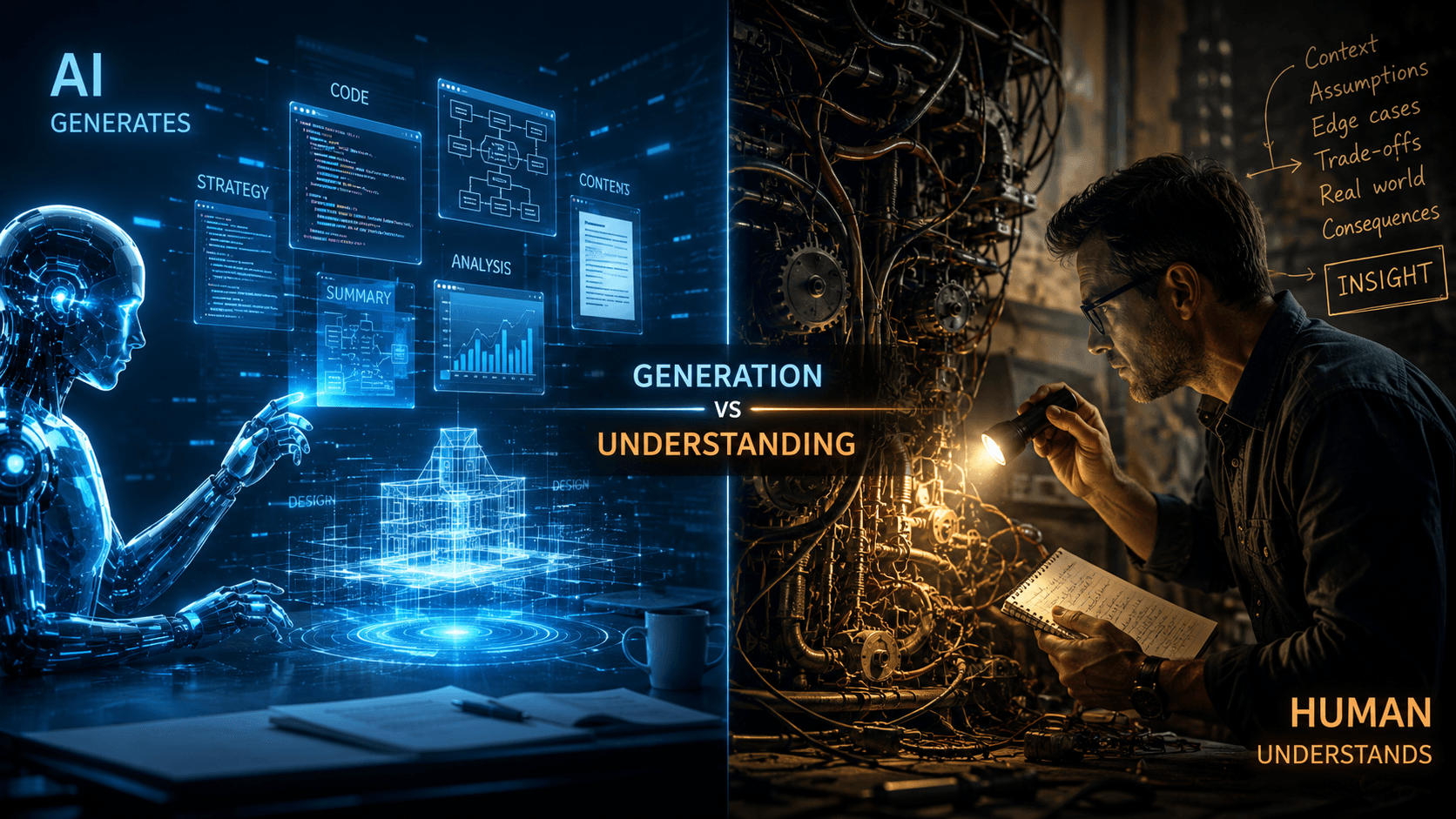
AI
Jun 23, 20264 min read
You Can Outsource Thinking. But You Cannot Outsource Understanding.
Smart people are starting to confuse speed with wisdom. You can generate a strategy deck in twenty minutes and ship code before lunch — but synthesis is not understanding. You can outsource thinking; you cannot outsource the part where meaning gets made.
A strange thing is happening in knowledge work right now. Smart people are beginning to confuse speed with wisdom.
You can feel it in meetings, in Slack threads, in the quiet confidence of someone who says, “AI already figured it out.” A strategy deck appears in twenty minutes. Code ships before lunch. A market analysis lands in your inbox with graphs, recommendations, and a tone polished enough to sound expensive. The friction is disappearing so quickly that many people are mistaking the disappearance of effort for the arrival of understanding.
But let me tell you something uncomfortable.
You can outsource thinking. You cannot outsource understanding.
That sentence matters more than most people realize.
For centuries, thinking carried visible labor. You wrestled with drafts, scribbled notes in margins, hit dead ends, stared at the ceiling while your mind tried to connect things that did not yet fit together. Effort became tangled with intelligence. If something took time, it felt meaningful.
AI has broken that relationship.
Now you can generate a business plan in six minutes, write production-ready code before your coffee cools, summarize a 200-page book while standing in line for lunch. It feels magical because, in many ways, it is. The machine can synthesize information at a scale and speed the human brain simply cannot match.
But synthesis is not understanding.
That distinction will define careers over the next decade.
AI is remarkably good at assembling patterns. Give it enough context and it can predict what a persuasive argument should sound like, what clean code should resemble, or what a good product roadmap typically contains. It can compress knowledge into something useful. Sometimes astonishingly useful.
Yet prediction is not wisdom.
Wisdom arrives slower. It comes from tension. Contradiction. Consequences. The strange emotional residue left behind after making decisions that did not work.
You know that moment when someone gives advice that sounds perfect on paper, but somehow feels hollow? Usually, it comes from someone who knows the theory but has never lived through the terrain. They can explain the map. They cannot describe the weather.
That is where humans still matter.
Humans contextualize.
Context is invisible until it becomes expensive to ignore.
Imagine two founders using the same AI model to solve a business problem. One asks for a go-to-market strategy and follows it exactly. The other pauses and says, “This sounds smart, but my customers are unusually skeptical, my market behaves irrationally, and trust moves slower here.” Same machine. Same intelligence layer. Completely different outcomes.
The difference is not intelligence.
It is judgment.
Psychologists sometimes talk about “cognitive ease,” the tendency to trust information that arrives smoothly and confidently. AI is dangerous precisely because it sounds certain. Even when partially wrong, it delivers answers with unsettling fluency. Our brains love fluency. We mistake it for truth.
This is why understanding matters.
Understanding is not the ability to repeat an answer. It is the ability to know when the answer breaks.
And nowhere is this becoming more obvious than in software development.
We are entering the age of vibe coding, where products emerge through prompts, abstractions, and increasingly autonomous systems. You describe what you want, and code appears. Features materialize faster than ever. For builders, it feels like a superpower.
Until something breaks.
Then comes the moment every engineer recognizes instantly: the bug no one understands.
The login flow fails only in edge cases. A database query slows the entire system under load. Security holes appear where abstraction hid complexity. Suddenly, the person who merely generated the code feels trapped inside a machine they no longer understand.
Because debugging is where borrowed intelligence gets exposed.
When everything works, generation feels enough. When things fail, understanding becomes priceless.
I have seen this pattern already. Teams shipping at extraordinary speed, powered by AI, only to hit walls they cannot diagnose because no one deeply understands the architecture beneath the polished outputs. They built a house quickly. Nobody learned where the pipes were hidden.
This is not an argument against AI. Quite the opposite.
You should absolutely outsource thinking.
Let the machine brainstorm. Let it summarize, synthesize, compare, draft, prototype, and challenge your assumptions. Offload the repetitive cognitive burden. Use it to expand the surface area of your ambition.
But never outsource the part where meaning gets made.
Ask harder questions.
- Why does this recommendation exist?
- What assumptions is this answer making?
- Where would this fail in my specific context?
- What am I missing because this sounds convincing?
Understanding begins the moment you stop accepting outputs at face value.
There is also something deeply human happening beneath all of this, something we rarely admit. Many people are drawn to AI because it relieves the anxiety of uncertainty. Thinking is exhausting. Ambiguity is uncomfortable. It feels good when a machine hands us an answer wrapped in confidence.
But growth has always lived inside friction.
The entrepreneur who survives learns through mistakes no strategy document predicted. The leader develops intuition after difficult conversations, failed hires, and moments of doubt. The engineer becomes exceptional not by shipping perfect code, but by spending painful nights tracing invisible failures back to their root cause.
Experience rewires judgment.
No model can hand that to you.
The people who thrive in the AI era will not be the ones who refuse the technology, nor the ones who surrender completely to it. They will be the ones who develop a strange dual skill: radical leverage paired with deep comprehension.
Fast, but thoughtful.
Efficient, but skeptical.
Capable of generating almost anything, while still knowing what deserves belief.
Because the real competitive advantage is quietly shifting.
It is no longer access to intelligence.
It is the ability to understand what intelligence is actually telling you.
What's one moment where AI gave you an answer that sounded brilliant, until reality proved otherwise? I'd love to hear the story.