
Back to Knowledge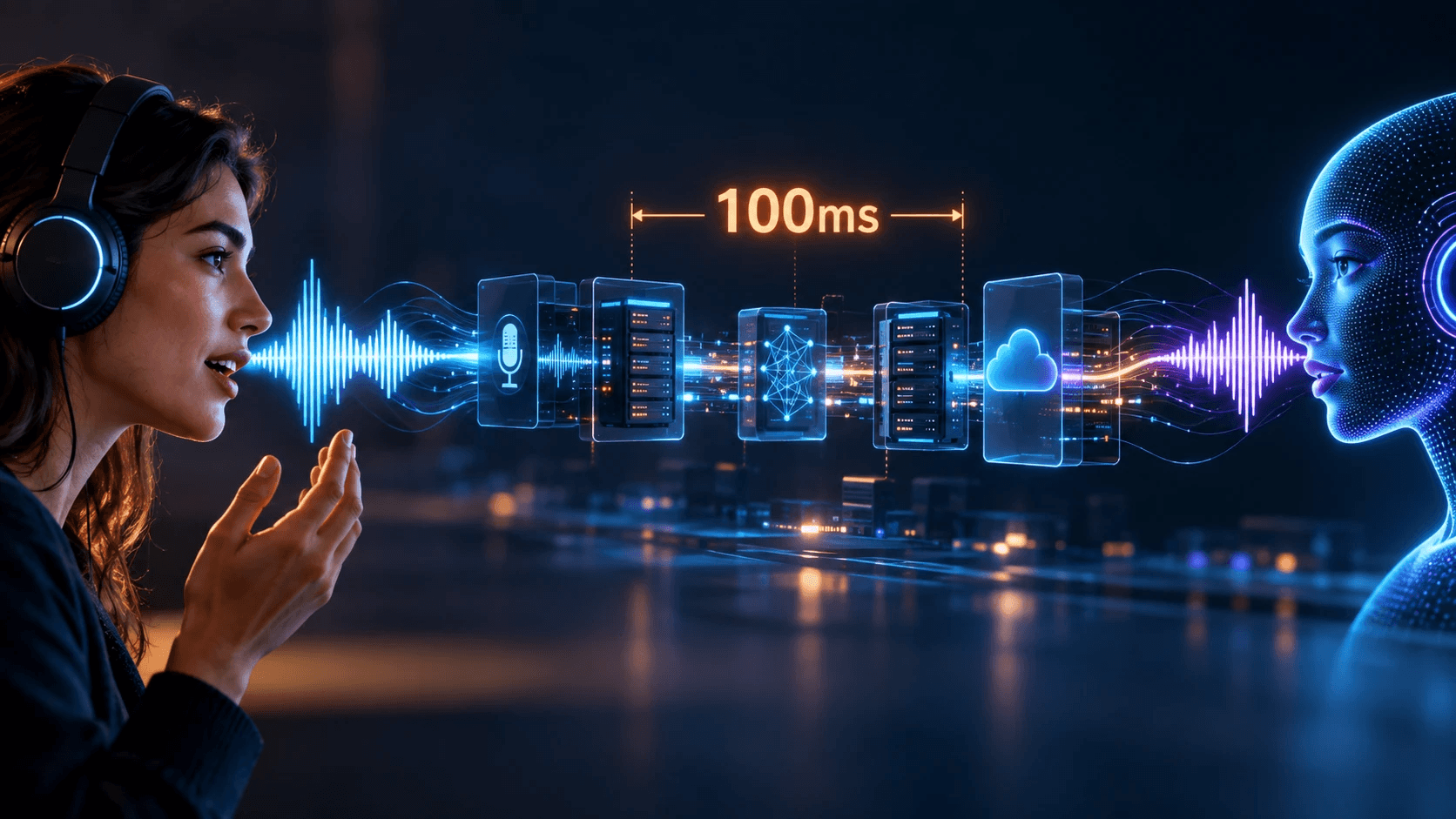
AI
Sep 23, 20265 min read
Voice AI Is Easy Until You Notice the 100ms Delay
A voice AI can be intelligent, natural, and accurate — and still feel like a machine. Humans are extraordinarily sensitive to conversational timing, and a chain of streaming systems has to behave like one organism to keep silence from turning into doubt. Optimize perceived latency, not just measured latency.
A voice AI demo can feel magical right up until the conversation feels slightly wrong. The words are intelligent, the voice is natural, the answers are accurate, yet something in the interaction makes you think, “Why does this feel like I’m talking to a machine?” Often, the answer is hiding inside a number most users will never see: 100 milliseconds.
Humans are extraordinarily sensitive to conversational timing. When you speak to another person, your brain is constantly predicting when they will respond, whether they are still listening, whether they are thinking, and whether you should continue. A tiny pause can communicate hesitation, confusion, empathy, interruption, or agreement. The same pause in a voice AI system can communicate something much simpler: the network is slow.
That is what makes realtime voice AI so difficult. The intelligence is only one layer of the experience. Underneath it sits a chain of systems that must behave almost like one organism: audio capture, voice activity detection, streaming transport, speech recognition, inference, tool calls, response generation, text-to-speech, audio playback, interruption handling, buffering, and network recovery. Each component can be fast in isolation and the overall conversation can still feel painfully slow.
Imagine calling an AI assistant and saying, “Can you move my meeting to tomorrow afternoon?” Your microphone captures the audio. The system decides that you have finished speaking. The audio travels across the network. Speech recognition begins decoding it. The model interprets the request. A calendar tool may be invoked. The response is generated. Text is converted back into speech. That audio travels back to you. Then your device finally starts playing the first few hundred milliseconds. Nothing looks broken. But your brain has already noticed the silence.
This is where latency becomes psychological rather than merely technical. If a system takes 600 milliseconds to respond, users do not experience “600 milliseconds.” They experience uncertainty. Did it hear me? Did the call drop? Is the assistant thinking? Should I repeat myself? Should I keep talking? The machine has introduced ambiguity into a channel where humans normally rely on timing to establish mutual attention.
That is why call-drop perception is such an interesting engineering problem. A connection can be perfectly alive while feeling dead. The packets are moving. The websocket is open. The server is healthy. The model is running. Yet a silent 700 milliseconds can make a user pull the phone away from their ear and check whether the call disconnected.
And the inverse is equally important. A system can begin speaking quickly even before it has completed everything. That first fragment of sound reassures the brain that the conversation is still active. “Yes, I can…” may arrive before the system has finished constructing the rest of the answer. Technically, you have not reduced every millisecond of computation. Experientially, you have changed what the user believes is happening.
This is why realtime AI infrastructure is fundamentally different from ordinary request-response software. In a traditional API, nobody cares if a response takes 400 milliseconds versus 700 milliseconds as long as the interface remains usable. In voice, latency compounds across a sequence of human expectations. Worse, the system has to manage overlapping streams rather than neatly separated requests. The user can start speaking while the AI is speaking. They can interrupt. They can change their mind halfway through a sentence. They can cough, hesitate, laugh, or say “uh” three times before finishing the thought.
Now the engineering problem gets interesting.
You need streaming transcription rather than waiting for an entire utterance. You need incremental model generation rather than waiting for the full answer. You need streaming speech synthesis rather than generating an entire audio file before playback. You need interruption detection that can distinguish a genuine barge-in from background noise. You need cancellation so that an obsolete response does not continue consuming compute after the user has already interrupted it.
And you need all of this while networks behave badly.
A voice pipeline is only as strong as its slowest moments. A model might respond in 80 milliseconds while a downstream service adds 300. Your inference server might be fast while a region-to-region network hop quietly adds another 120. Your TTS engine might generate audio quickly, but buffering decisions can delay when the first byte actually reaches the speaker. The complexity is hidden because the user does not see the architecture. They simply hear silence.
Optimize perceived latency, not just measured latency.
That is the deeper lesson here for engineers building AI products. It does not mean cheating the metric. It means understanding the human system receiving the metric. A progress indicator can make a web request feel faster. A streaming response can make an LLM feel dramatically more responsive. In voice, the equivalent is maintaining conversational continuity. Start producing useful audio as soon as confidence is high enough. Stream aggressively. Keep connections warm. Move computation closer to the user. Avoid unnecessary serialization between services. Instrument every stage of the pipeline, not just end-to-end response time.
And measure the moments users actually feel.
Track time-to-first-audio. Track interruption recovery. Track silence duration after the user finishes speaking. Track how often users repeat themselves. Track how often they say “hello?” after the system should already have responded. These are not merely UX metrics. They are signals about whether your infrastructure is preserving the illusion of a live conversation.
The strange thing about voice AI is that the hardest engineering work often produces the least visible feature. Nobody will congratulate you because the audio starts 90 milliseconds earlier. Nobody will notice that you reduced jitter across three regions or shaved 40 milliseconds from a streaming pipeline. They will simply feel that the assistant is responsive.
That is the standard.
The future of voice AI will not be decided only by which model understands language best. It will also be decided by which systems understand time best.
Because when humans talk, silence is never just silence. It is information, expectation, and sometimes the moment when trust quietly disappears.
Have you ever built or used a voice system where the intelligence was impressive but the conversation still felt strangely broken? I’d love to hear what caused it, and what you changed to make it feel human again.