
Back to Knowledge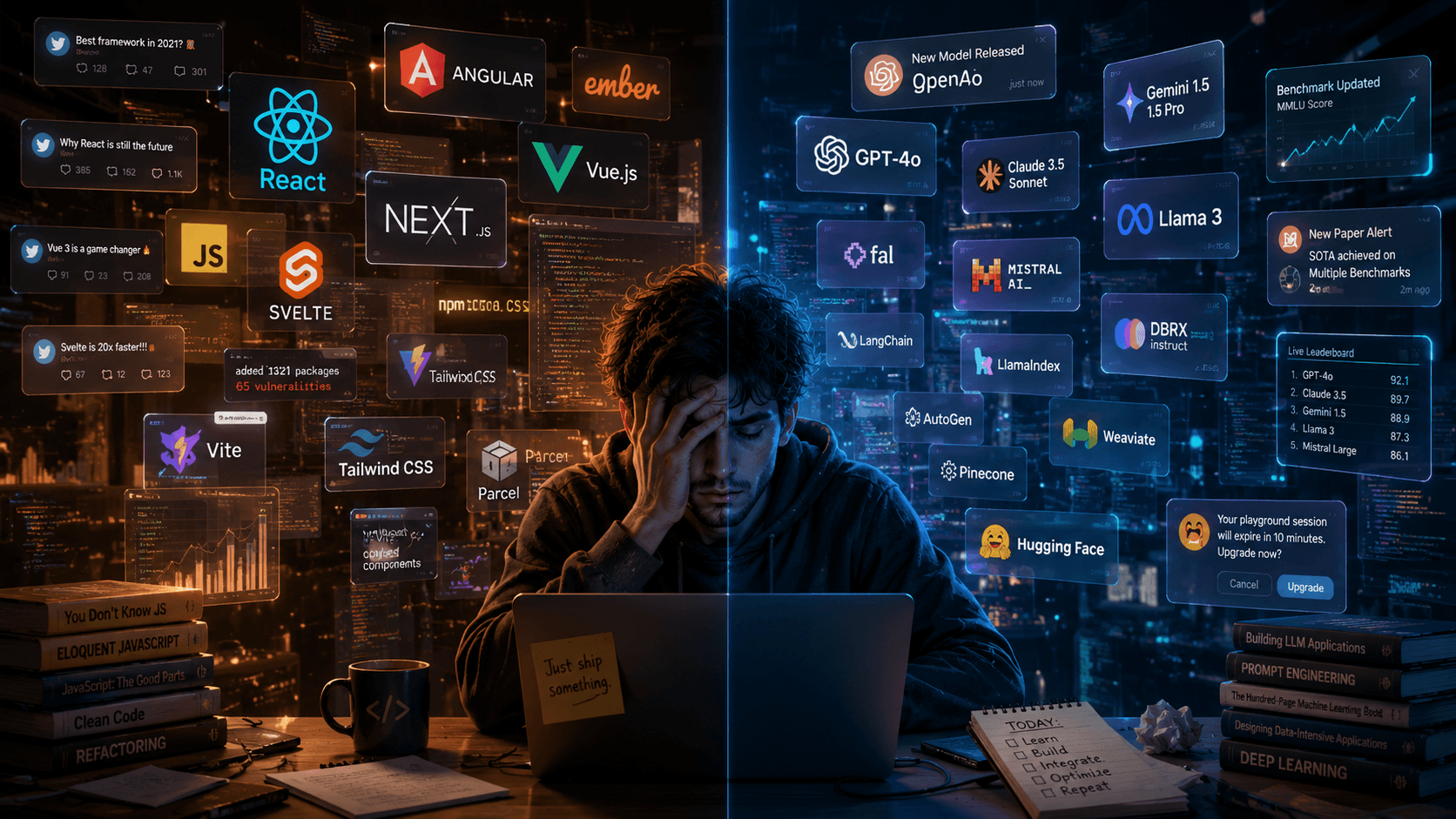
AI
Jul 7, 20266 min read
Three Years Ago It Was JavaScript Frameworks. Today It's AI Models.
Three years ago engineers asked which JavaScript framework to bet on. Today it's which AI stack will still matter in six months. Different nouns, same anxiety — and the exhaustion is no longer technical. It's existential.
A few years ago, every engineer I knew was tired in the exact same way.
Not physically tired. Cognitively tired. The kind of exhaustion that comes from opening Twitter on a Tuesday morning and discovering that the framework you spent six months learning was suddenly “dead,” replaced by another framework that looked suspiciously identical but came with a shinier logo and a 17-part thread explaining why everything before it was architecturally flawed.
You remember that era.
React versus Vue. Next.js versus Remix. Tailwind versus traditional CSS. Vite replacing Webpack. Then Turbopack arriving before half the industry had even finished migrating. Every conference felt like speed dating for abstractions. Every senior engineer secretly worried they were becoming obsolete because they hadn't watched the latest three-hour YouTube tutorial with a neon thumbnail and the words “THIS CHANGES EVERYTHING.”
What's fascinating is that most people thought that phase was uniquely chaotic.
It wasn't.
It was rehearsal.
Because today the same psychological storm has returned, except this time the terrain is AI models, agents, vector databases, MCP servers, orchestration frameworks, fine-tuning pipelines, synthetic memory systems, inference optimizations, multimodal architectures, and an endless parade of benchmarks that somehow become irrelevant within fourteen days.
Three years ago, engineers asked, “Which JavaScript framework should I bet on?”
Today they ask, “Which AI stack will still matter six months from now?”
Different nouns. Same anxiety.
And here's the uncomfortable truth nobody wants to admit: the exhaustion is no longer technical. It's existential.
You can feel it in conversations with smart engineers who were once deeply confident people. They open LinkedIn and see someone building an autonomous coding agent over a weekend. They watch a founder casually mention replacing entire workflows with a model released forty-eight hours ago. They hear phrases like “reasoning breakthrough” and “state-of-the-art” so often that language itself starts losing meaning.
At some point, the brain stops processing innovation as opportunity and starts processing it as threat.
That's the real story of this AI era.
Not intelligence.
Velocity.
Let me tell you something I've noticed inside engineering teams recently. The strongest developers are no longer the ones who know the most tools. They're the ones who have learned how to remain psychologically stable while the ground keeps moving underneath them.
That sounds dramatic until you experience it firsthand.
One engineer spends months mastering an orchestration framework. Suddenly a new model release makes half the architecture unnecessary. Another team builds an elaborate RAG pipeline, only to realize newer long-context models can brute-force parts of the problem more simply. A startup raises money around prompt engineering workflows just before agents begin absorbing those workflows into larger autonomous systems.
People are not just updating skills anymore. They are constantly renegotiating identity.
And identity shifts are exhausting.
Psychologists have a term called “continuous partial attention.” It describes a state where your mind is never fully resting because it's constantly scanning for what might matter next. That is exactly how modern engineers consume AI news. Every tab feels potentially career-relevant. Every announcement feels dangerous to ignore.
You wake up intending to focus on your actual work. Then someone posts a benchmark comparison. A new open-source model drops. A founder claims their tiny team replaced ten operational roles using agents. Before lunch, you've consumed six conflicting opinions and absorbed just enough information to feel behind.
Not informed.
Behind.
The AI ecosystem has accidentally industrialized professional insecurity.
What makes this particularly brutal for engineers is that engineering culture rewards adaptation. Curiosity is good. Experimentation is good. Staying current is good. But there's a hidden psychological trap there. When an industry moves slowly, curiosity feels energizing. When an industry moves at machine speed, curiosity can quietly become compulsion.
And compulsions don't feel healthy. They feel urgent.
You know that moment when you're halfway through reading about one model release and another one appears before you've even processed the first? That's not just information overload. That's cognitive fragmentation. Your attention stops forming deep mental models because it's trapped in survival mode, bouncing between updates like a pinball machine.
Ironically, this creates weaker engineers, not stronger ones.
Because real technical depth requires boredom. It requires staying with a problem long enough to understand its texture. The AI ecosystem often punishes that patience. It whispers: move faster, consume more, switch contexts again.
The result is a generation of highly informed but mentally scattered builders.
And yet, beneath all this chaos, something important is happening.
Engineers are slowly learning that the winning skill is no longer predicting the exact technology. It's developing resilience to technological volatility itself.
That changes everything.
The developers who survive this era won't necessarily be the ones who perfectly forecast the dominant model provider or orchestration framework. They'll be the ones who can repeatedly learn, discard, rebuild, and adapt without emotionally collapsing every time the ecosystem shifts direction.
In other words, emotional adaptability is becoming technical leverage.
That sounds soft until you watch two equally talented engineers respond differently to change. One spirals every time the landscape evolves. The other treats change as weather. Same storm. Different nervous system.
And companies are beginning to notice.
I recently spoke with a startup founder who said something surprisingly revealing. He told me that during interviews, he no longer looks for candidates who claim certainty about the future AI stack. He looks for people who can think clearly despite uncertainty. People who can hold strong opinions loosely. People who experiment aggressively without tying their self-worth to being right.
That's a profound shift from the old engineering archetype.
For years, technical credibility came from knowing the answer. In the AI era, credibility increasingly comes from navigating ambiguity without panic.
There's another layer to this that rarely gets discussed.
A lot of engineers secretly miss slower technological eras.
Not because they dislike progress, but because slower ecosystems allowed mastery to feel durable. You could spend years becoming exceptional at something and reasonably expect that knowledge to compound over time. Today, many people feel trapped on an endless treadmill where expertise expires faster than confidence can form.
That creates a strange emotional atmosphere inside the industry. Everyone is learning constantly, yet many people feel perpetually inadequate.
The tragedy is that most of them are doing far better than they think.
Because beneath the noise, the core skill hasn't changed nearly as much as people imagine. Great engineers still reduce complexity. They still understand systems. They still think probabilistically. They still communicate clearly. They still build things that solve real human problems.
The interfaces changed.
The fundamentals didn't.
And maybe that's the real awakening of this phase.
The future does not belong to the people who chase every new model release like day traders chasing candles on a chart. It belongs to the people who can absorb change without becoming consumed by it. People who know when to explore and when to ignore. People who can distinguish signal from theater.
That's harder than learning another framework.
It's harder than learning another model.
Because it requires mastering your own attention.
I'm curious how other engineers are experiencing this moment. Do you feel energized by the pace of AI, exhausted by it, or somehow both at the same time? What's changed most in the way you learn and work compared to three years ago?