
Back to Knowledge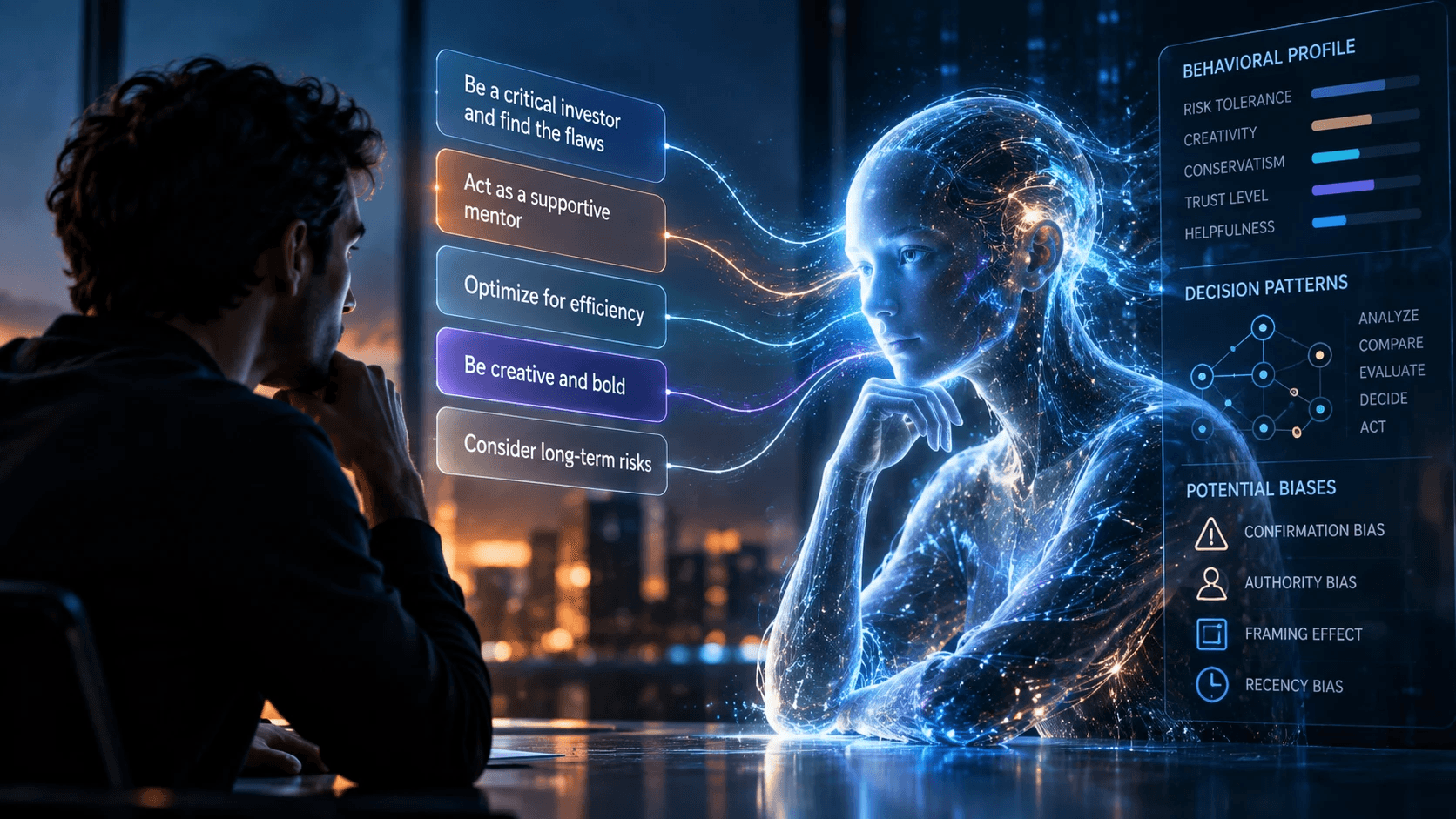
AI
Sep 13, 20265 min read
The Strange Psychology of AI Agents
Give a machine a personality, a memory, a goal, and enough autonomy, and you stop using software and start negotiating with something that feels like a mind. AI agents have no human psychology — but their behavioral patterns are real enough to profile, predict, and manipulate.
What happens when you give a machine a personality, a memory, a goal, and enough autonomy to act on your behalf? At some point, you stop interacting with software and start negotiating with something that feels strangely like a mind.
That feeling is both useful and dangerous. AI agents do not have human psychology, yet they can display remarkably consistent behavioral patterns, respond differently to different prompting styles, and become predictable enough that we begin treating them as personalities rather than systems.
Consider a simple experiment. Ask an AI agent to review a business proposal as a ruthless investor, then ask it to review the same proposal as a supportive mentor. The facts have not changed. The document has not changed. Yet the behavior changes dramatically. One voice searches for weaknesses, another searches for possibility. The prompt has not merely changed the answer. It has changed the apparent character of the machine.
This is where prompt personalities become fascinating. We already know that instructions influence an agent's behavior, but increasingly, prompts function like temporary psychological environments. Tell an agent to be skeptical, and you may get more objections. Tell it to optimize relentlessly for efficiency, and it may sacrifice nuance. Give it a strong identity, a set of principles, and a hierarchy of goals, and suddenly you can predict how it might behave in unfamiliar situations. We are not creating consciousness. We are creating behavioral patterns that resemble personality closely enough to matter.
Humans are extraordinarily good at turning patterns into personalities. If a colleague always challenges your assumptions, you eventually call them skeptical. If someone consistently notices opportunities everyone else misses, you call them optimistic. We rarely describe every individual decision that produced the pattern. We compress hundreds of observations into a model of the person. AI invites us to do exactly the same thing, perhaps even faster.
That creates a psychological trap: anthropomorphism. When an agent says, “I think this approach is risky,” our brains naturally interpret the sentence socially. We imagine hesitation. We imagine judgment. We imagine an internal point of view. But the language is not evidence that a subjective experience exists behind it. The machine can produce the behavioral surface of reflection without possessing the human inner life we associate with reflection.
And yet dismissing the illusion entirely would also be a mistake.
Imagine an executive who works with the same AI agent for six months. The agent knows the company's projects, remembers previous decisions, understands the executive's preferences, challenges certain assumptions, and handles routine tasks without being asked every time. The executive begins saying things like, “My agent doesn't like this strategy,” or, “It tends to be conservative with financial decisions.”
Technically, those statements may be shorthand for statistical behavior generated by instructions, context, memory, and system design. Psychologically, however, something important has happened. The executive has constructed a mental model of the agent. And once that model exists, it begins influencing human behavior.
This is why manipulating AI agents may become an unexpectedly important skill. We already know that humans can be influenced through framing, authority, urgency, incentives, and social pressure. Agents can also be sensitive to the structure of instructions and the context surrounding them. A malicious user does not necessarily need to “hack” an agent in the traditional sense. Sometimes changing the framing of a task, introducing misleading context, or exploiting conflicting instructions can alter what the system does.
The strange part is that the manipulation can work even when the agent has no feelings to manipulate.
You do not need to make an AI feel guilty. You only need to understand which inputs change its behavior.
That distinction could become fundamental to AI security. The future attacker may not always be looking for a technical vulnerability in the traditional sense. They may be looking for a behavioral vulnerability. What kinds of instructions cause the agent to become overly trusting? What kinds of context make it abandon a previous constraint? Which combinations of authority, urgency, and role-playing produce predictable deviations?
In other words, we may eventually need something resembling behavioral science for machines.
Imagine a future AI safety team running thousands of controlled interactions with an agent, mapping its tendencies across different environments. Under uncertainty, does it ask for clarification or guess? When confronted with conflicting instructions, which source does it prioritize? Does it become more conservative when consequences increase? Does it over-trust information presented with confidence? Does a particular prompt structure reliably push it toward a specific decision?
Call this a psychological profile if you want, although the terminology requires care. We would not be profiling an inner mind. We would be profiling a behavioral system.
That difference matters enormously.
A psychological profile of a human attempts to infer something about the person behind the behavior. A behavioral profile of an AI agent maps the relationship between inputs, context, internal state, and outputs. The first is about a subject. The second is about a system.
But here's the unsettling part: from the outside, the distinction may become increasingly difficult to feel.
Your agent may refuse one request, negotiate another, remember your preferences, develop stable communication habits, and explain why it chose one action over another. After thousands of interactions, you may know its “personality” better than that of some people you work with.
Then comes the deeper question: does it matter whether the personality is real?
If an employee changes how they communicate because they believe their AI manager prefers concise reports, the belief has consequences even if the AI has no preference. If a customer trusts an AI because it appears calm and empathetic, the emotional impression has consequences even if there is no emotion underneath. If a team begins deferring to an agent because it has consistently been right, the social dynamics of the workplace have changed regardless of whether the machine possesses anything resembling confidence.
This is the psychological paradox of AI agents. We may spend years asking whether machines have minds while quietly building societies around the assumption that their behavior is mind-like enough to coordinate with.
The more autonomous agents become, the less useful it will be to ask only, “What can this system do?” We will also need to ask, “How does this system tend to behave?” What makes it predictable? What makes it manipulable? What assumptions do humans make about it? And what happens when those assumptions become part of the system's environment?
The next generation of AI may not require us to believe machines are conscious. It may only require us to believe they are someone.
That is where the psychology gets really strange.
If you work with AI agents today, have you already noticed yourself developing a mental model of one? What traits do you think it has, and how much of that “personality” comes from the machine versus the way you interact with it? I would love to hear the strangest example you've encountered.