
Back to Knowledge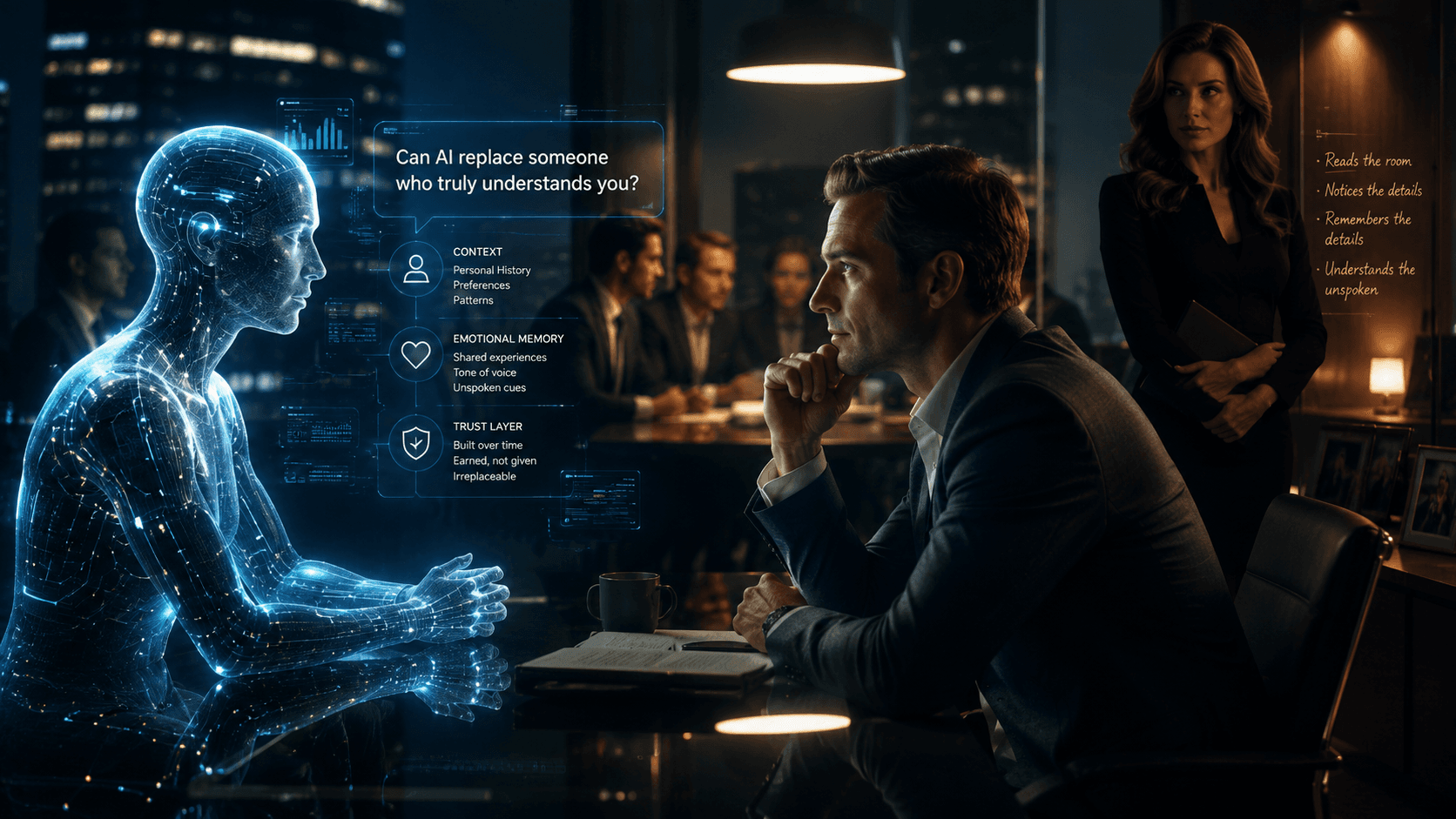
AI
Jun 16, 20265 min read
Can AI Replace Someone Who Truly Understands You?
The most valuable person in your life is rarely the smartest one in the room — it's the one who gets you before you finish the sentence. Intelligence has become abundant. Understanding has not. So the better question isn't “How do I compete with machines?” but “Am I becoming someone who truly understands people?”
Ever notice how the most valuable person in your life is rarely the smartest one in the room?
It is the person who gets you before you finish the sentence. The friend who notices something is wrong from the way you say “I'm fine.” The colleague who can predict your reaction before the meeting begins. The mentor who somehow knows whether you need advice, pressure, or silence.
We are entering an age obsessed with intelligence, yet quietly rediscovering something stranger and more powerful: understanding.
Let me tell you a story.
If you have watched Suits, you probably remember Donna. Not because she had the law degree, the sharpest technical expertise, or the biggest title. Donna mattered because she understood people at a level that felt almost supernatural. She could walk into a room, read emotional weather in seconds, anticipate conflict before it erupted, and know exactly what Harvey Specter needed before he asked.
That is why she became indispensable.
Not irreplaceable because of information. Irreplaceable because of context.
And context, especially human context, is where this conversation about AI gets uncomfortable.
We keep asking the wrong question.
“Will AI replace jobs?”
The more unsettling and fascinating question is this:
Can AI replace someone who truly understands you?
At first glance, the answer feels obvious. AI is improving at terrifying speed. It remembers preferences, predicts behavior, finishes your sentences, writes emails, suggests decisions, and increasingly acts like an intellectual partner. For many forms of knowledge work, it already feels uncannily capable.
But capability and understanding are not the same thing.
You know that moment when someone remembers a version of you that even you forgot? Maybe they say, “You always pull away when you are overwhelmed,” or “This sounds like what happened before your last big career shift.” Suddenly, they are not responding to the words in front of them. They are responding to your history.
That changes everything.
Because human understanding is rarely transactional. It accumulates slowly, like invisible architecture. A thousand conversations. Tiny disappointments. Shared jokes. Contradictions observed over years. The version of you that appeared confident while quietly terrified. The ambition you speak about publicly versus the fear you whisper privately.
This is what I call emotional memory.
Not memory in the technical sense. Memory with meaning.
A great manager knows when an employee says, “I'm stuck,” what they really mean. Burnout. Fear of disappointing people. Quiet confusion. A great partner hears irritation and recognizes grief underneath it. A trusted colleague notices hesitation in your voice and knows exactly when to push and when to step back.
These people become what psychologists might call high-context humans.
They operate with layered awareness. They do not just process information. They process patterns.
And here is the uncomfortable truth for anyone predicting total AI replacement: high-context humans are disproportionately valuable.
Because intelligence has become abundant.
Understanding has not.
A few weeks ago, I spoke to a founder who told me something revealing. He had started using AI constantly for strategy, writing, and decision-making. “It makes me faster,” he said. “But when I'm confused about myself, I still call one person.”
One person.
Not because the advice was always objectively better. Sometimes it was worse. Sometimes irrational, emotional, incomplete.
But this person understood the founder's hidden operating system. They knew his patterns of self-sabotage. They knew when he was acting from fear disguised as logic. They knew the difference between temporary exhaustion and genuine misalignment.
That level of trust cannot be manufactured overnight.
Trust, after all, is not built through correctness alone. It is built through witnessed experience.
Think about that for a moment.
The people you trust most are not necessarily the people who have always been right. They are the people who have been present enough to understand the shape of your mind.
This is where many conversations about AI become strangely simplistic. We compare intelligence as if humans are calculators competing against better calculators.
But humans were never only valuable because of raw intelligence.
The best therapist is not simply someone with information about psychology. The best leader is not merely strategic. The best teacher remembers the insecurity behind your confidence. The best friend understands your silence.
Human intuition lives in ambiguity.
Ever wonder why certain people feel emotionally safe within minutes while others feel exhausting despite saying all the “right” things?
Your nervous system is making judgments faster than conscious thought. Tiny signals. Tone shifts. Microexpressions. Contradictions between language and energy. We are constantly reading each other in ways language barely captures.
AI may become extraordinary at pattern recognition. In many ways, it already is. It may even simulate empathy so convincingly that the distinction becomes blurry.
But simulated understanding and earned understanding are psychologically different experiences.
One predicts.
The other remembers.
And memory creates emotional gravity.
Still, there is a twist here that many people miss.
AI does not necessarily need to replace high-context humans to transform relationships. In fact, it may amplify them.
Imagine a manager who uses AI to remove administrative noise so they can pay deeper attention to people. Imagine a doctor who spends less time on paperwork and more time noticing fear in a patient's expression. Imagine friendships strengthened because technology removes friction instead of attention.
The future may not belong to humans competing with AI.
It may belong to humans who become more deeply human because AI handles the mechanical layers of work.
Which brings me back to Donna from Suits.
People often underestimated her because they confused expertise with value. But Donna represented something timeless. She understood people deeply enough to become strategically essential.
The real power was not intelligence.
The real power was perception.
And perception, especially when layered with emotional memory and trust, is incredibly difficult to replace.
So perhaps the better career question in the age of AI is not:
“How do I compete with machines?”
Maybe it is:
“Am I becoming someone who truly understands people?”
Because the future may reward those who can do something algorithms still struggle to earn:
Become trusted.
I'm curious. Think about the person you trust most for important decisions. What makes them irreplaceable to you?