
Back to Knowledge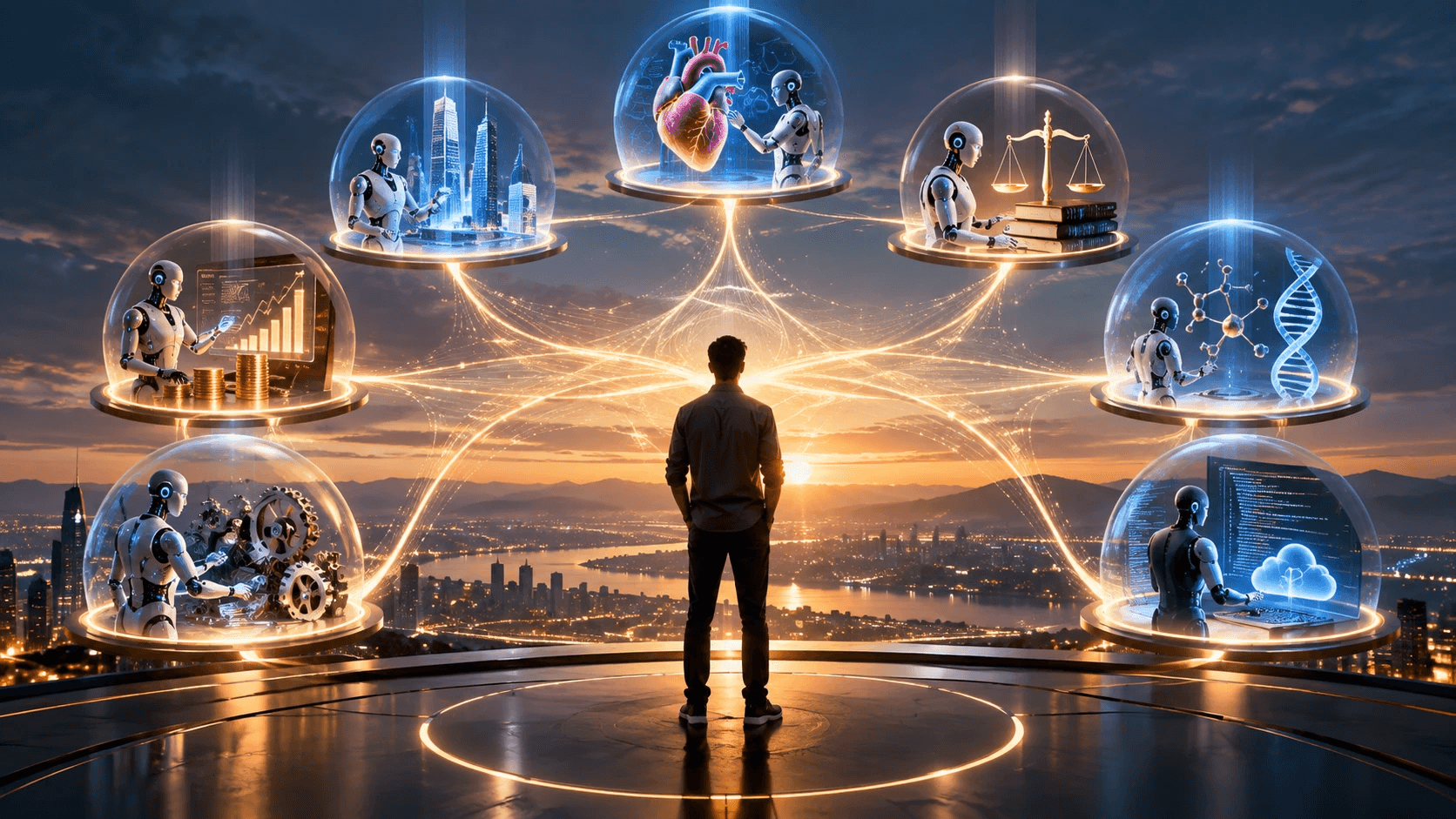
AI
Sep 18, 20265 min read
AI Is Becoming Specialist. Humans Are Becoming Generalists.
Machines aren't just getting smarter — they're getting narrower, deeper, and extraordinarily good at specific things. Meanwhile the most valuable humans are moving the other way: broader, more curious, and better at connecting ideas from fields that were never supposed to meet.
The strange thing about the AI revolution is that machines are not simply becoming smarter. They are becoming narrower, deeper, and extraordinarily good at specific things. At the same time, the most valuable humans may be moving in the opposite direction: becoming broader, more curious, and better at connecting ideas that were never supposed to meet.
For centuries, expertise was built through depth. You studied one discipline, spent years mastering its language, earned the credentials, and gradually became the person others came to when they needed something difficult done well. Depth was scarce, and scarcity created value. But AI is beginning to attack that scarcity from an unexpected direction. Give a powerful model enough context, examples, tools, and feedback, and it can become remarkably capable inside a narrow domain.
Imagine an AI trained specifically to analyze cardiac imaging, another built to optimize supply chains, another that understands semiconductor design, and another that can review thousands of legal contracts against a precise set of rules. None of these systems needs to become a complete human being. They just need to become exceptionally good at the thing they were built to do.
That changes the economic meaning of expertise. The question is no longer simply, “How deeply do you know your field?” It increasingly becomes, “What can you see that exists between fields?”
Consider a product manager working on a healthcare app. Ten years ago, being competent might have meant understanding product development, user research, analytics, and the healthcare market. Today, AI can increasingly provide specialist-level assistance across each of those layers. It can summarize research, analyze feedback, draft experiments, inspect regulations, generate interface concepts, and model possible outcomes. The human advantage begins to shift somewhere else.
The advantage becomes knowing that a behavioral economics principle might solve a product adoption problem. That a lesson from aviation could improve incident management. That a supply-chain concept could explain why a software organization keeps missing deadlines. That a psychological insight about loss aversion might matter more to a pricing strategy than another hundred rows in a spreadsheet.
This is where interdisciplinary thinking stops being an intellectual luxury and becomes a practical advantage.
The generalist is often misunderstood. We picture someone who knows a little about everything and therefore lacks mastery of anything. That version of generalism is becoming less useful. The emerging generalist is different. They do not compete with machines by knowing more facts. They compete by knowing which facts matter, how different systems interact, and where an insight from one domain can unlock a problem in another.
Think of a conductor standing in front of an orchestra. The conductor does not play every instrument better than the musicians. That is not the point. The value comes from hearing the relationship between the instruments and shaping them into something coherent. In an AI-rich world, humans may increasingly play a similar role.
There is also a psychological reason this shift will be uncomfortable. Expertise gives us identity. Saying “I am a lawyer,” “I am an engineer,” or “I am a marketer” provides a stable answer to the question of who we are. Generalism asks us to loosen that grip. It asks us to become comfortable saying, “I am learning this now,” even after years of being the person who was supposed to already know.
That can feel like losing status when it is actually gaining range.
I have seen a similar pattern in creative work. Someone who once needed a designer, researcher, copywriter, analyst, and developer to move an idea forward can now use AI to access meaningful assistance across all five. The bottleneck moves. It is no longer just production. It becomes judgment, taste, context, prioritization, and the ability to decide what should exist in the first place.
This does not mean specialists disappear. Quite the opposite. AI itself is becoming more specialized, and human organizations will still need deep expertise in medicine, engineering, law, science, finance, security, and hundreds of other domains. The difference is that specialists may increasingly work alongside specialized AI systems, while humans who can connect those specialists may become disproportionately valuable.
Picture an architect working with an environmental scientist, a behavioral researcher, an economist, and an AI system. The breakthrough may not come from any one expert. It may come from the person who notices that the assumptions of one discipline contradict the assumptions of another.
That person is a translator.
And translation is becoming a strategic skill.
The deepest opportunity may therefore sit at the intersection of breadth and depth. You still need enough depth to recognize a meaningful idea when you encounter it. But you also need enough breadth to encounter ideas outside your normal territory. Depth gives you credibility. Breadth gives you combinations. The real advantage comes from knowing when to use each.
AI makes this more interesting because it dramatically lowers the cost of exploring unfamiliar territory. You can ask questions that would once have required hours of research. You can have a concept explained at three levels of complexity. You can simulate alternative perspectives. You can move from economics to neuroscience to software architecture in a single afternoon without pretending you have become an expert in any of them.
That creates a new kind of intellectual freedom.
You no longer need permission to be curious.
And curiosity may become one of the most economically valuable habits of the next decade.
The irony is beautiful. We built machines to automate narrow tasks, and in doing so, we may have created more room for humans to become less narrow. AI can specialize relentlessly. Humans can connect relentlessly.
So perhaps the future does not belong to the person who knows the most about one thing, or even the person who knows a little about everything. It belongs to the person who can move intelligently between worlds, recognize patterns across boundaries, ask better questions, and turn disconnected knowledge into a useful idea.
The career advantage may increasingly belong to the person who can say, “I don't know this field yet, but I know how to learn it, question it, connect it, and use it.”
That is not the end of expertise.
It is the beginning of a different kind of expertise.
If AI is becoming specialist, perhaps our job is not to become more machine-like. Perhaps our job is to become more human in the most powerful sense of the word: curious enough to cross boundaries, humble enough to keep learning, and imaginative enough to connect dots that nobody thought belonged on the same page.
What two completely different fields have taught you something unexpectedly useful about your own work? I would love to hear the connection.